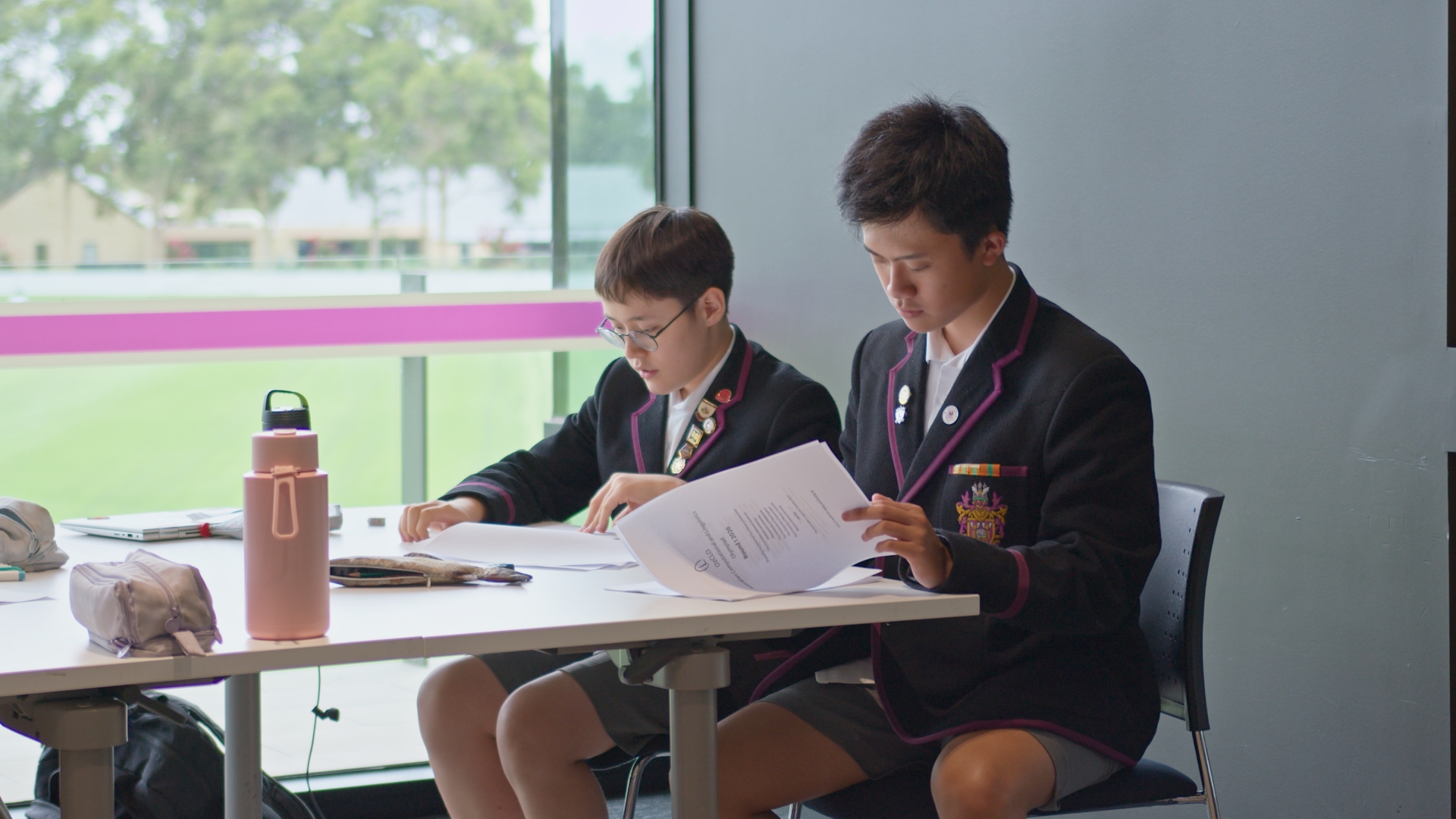
Students decode language puzzles at nationals
From solving language puzzles to discovering word patterns, the Australian Computational and Linguistics Olympiad (OzCLO) inspires students to use logic, reasoning, linguistic and computational thinking.
The rigorous contest challenges students to work in teams of four to solve problems, understand and find patterns in written and spoken languages.
This year was a special milestone, with students from Years 9–12 from all Haileybury Melbourne campuses and Haileybury Pangea online school participating. The opportunity was open to all students who had joined the Haileybury Linguistics Society, giving those interested in languages the chance to expand their skills and also to represent Haileybury.
In preparation students attended twice-weekly virtual training sessions in the months leading up to the state competitions. During the sessions, students used online tools such as collaborative whiteboard spaces and group OneNote boards to learn and support each other.
“OzCLO is a great way to use language skills in a competitive format, which is rare, and it is a great way to challenge our high achieving students,” explains Senior School teacher Mary Triantafyllou.
The blend of students in the teams further fostered an atmosphere of teamwork, personal development and learning.
“It was great to see the senior students mentoring and guiding the juniors, as well as the creative insights and enthusiasm of the younger students,” commented Mary.
Haileybury students rose to the challenge, with one team advancing to the nationals and earning a Bronze Award, which placed them in the top half of teams across Australia.
“It was very interesting to find out how languages around the world differ, as we expanded our horizons beyond conventional English grammar rules. We particularly enjoyed learning about semantics puzzles; they required more creativity to solve as we had to think outside the box, exploring how emotional or complex meanings could be divulged from literal ones,” explained the Year 10 students on the nationals team, Ara, Anna, Ruyi and Christian.
They said their favourite problem involved translating words between the Dhivehi language and English. They met the challenge by decoding the “grammatical and linguistical rules regarding the writing system.”
“This is a huge achievement as it is very rare that students qualify for the national round at all,” commented Mary.
The event is so challenging for students “because they have to interpret and use languages that they have never seen before in a competitive format,” explained Mary.
Often questions are not straightforward, and students need to lean heavily upon deductive reasoning, pattern recognition, time management and exam resilience to succeed.
At the end of the event there was a real sense of pride and achievement, knowing they had met some truly challenging goals.